

Bernard Loiseau was one of France’s most celebrated chefs—a gastronomic virtuoso whose Burgundy restaurant used to welcome celebrities, politicians and the very wealthy. He had published best-selling cookbooks. He regularly cooked on French TV and was paid to endorse popular foods. He had been honored with France’s greatest order of merit, the Légion d’honneur. And his restaurant— La Côte d’Or—had been awarded three stars by the Michelin Guide. But in February 2003, after finishing his lunchtime service, the 52-year-old drove home, climbed the stairs to his bedroom, locked the door, and shot himself dead with a hunting rifle. Although he had been suffering from depression, some within the trade suggested it might have been the threat of losing a Michelin star that had pushed this renowned perfectionist over the edge. One cannot overplay the influence of the Michelin Guide within the world of haute cuisine.
For most of the 20th century, this much-consulted series of red guidebooks, which has since largely con-verted to online, was by far the most important arbiter of restaurant quality worldwide. Chefs and maître d’s, especially in France where the guide was born, quiver at the thought of inspectors paying secret visits to their establishments. Michelin stars—up to a maximum of three for restaurants where “the cooking elevates the craft to an art form”—are considered by many the ultimate accolade in the restaurant business.
Gen Z diners are eschewing the Michelin Guide and following the recommendations of alternative guides such as the World’s 50 Best Restaurants. Chef Mitsuharu Tsumura’s Maido restaurant in Lima, Peru is currently top of the latter.
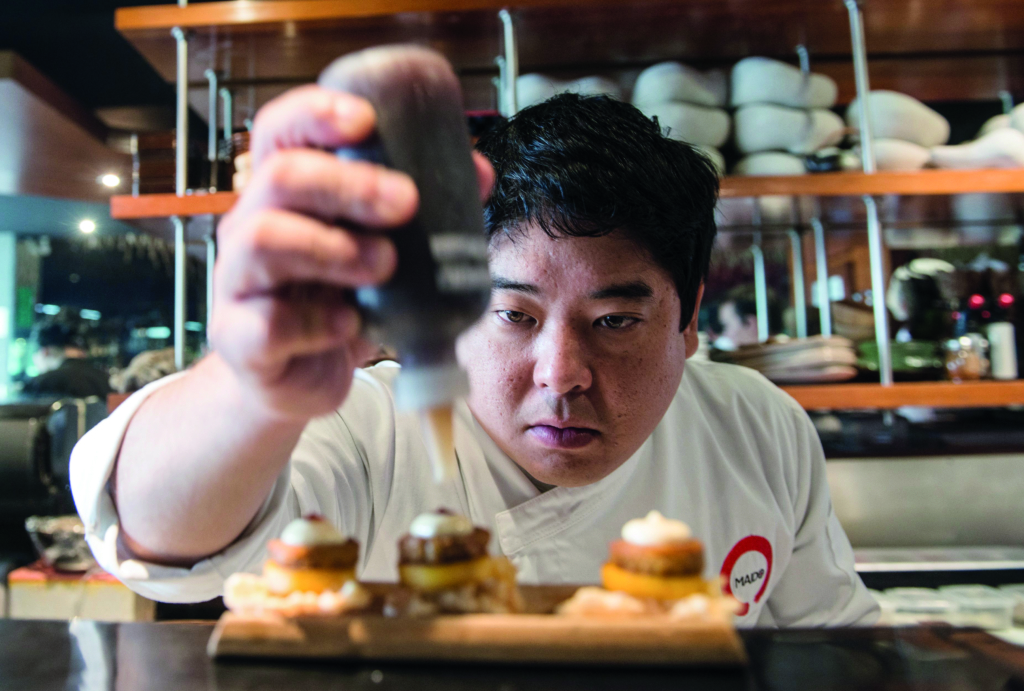
But is the guide still the force it once was? Michelin’s position as top dog seems now to be under threat. For Generation Z, at least, influencers, social media and more fashionable restaurant guides— such as The World’s 50 Best Restaurants, LaListe, Tripadvisor, OpenTable, World of Mouth—offer more important recommendations.
The first Michelin guidebook appeared in 1900 when brothers André and Edouard Michelin realised that useful maps, travel tips, and recommendations for gas stations, mechanics, hotels and restaurants would encourage more road travel, thereby boosting sales of the tires they manufactured. By the 1920s, the brothers had recruited a team of mystery diners—or restaurant inspectors, as Michelin now calls them. It was in the 1930s that the Michelin star rating system was established, with one star signifying “a very good restaurant in its category”; two stars denoting “excellent cooking, worth a detour”; and three stars signaling “exceptional cuisine, worth a special journey”. As the century progressed, so did guidebook sales, eventually reaching 30 million worldwide.
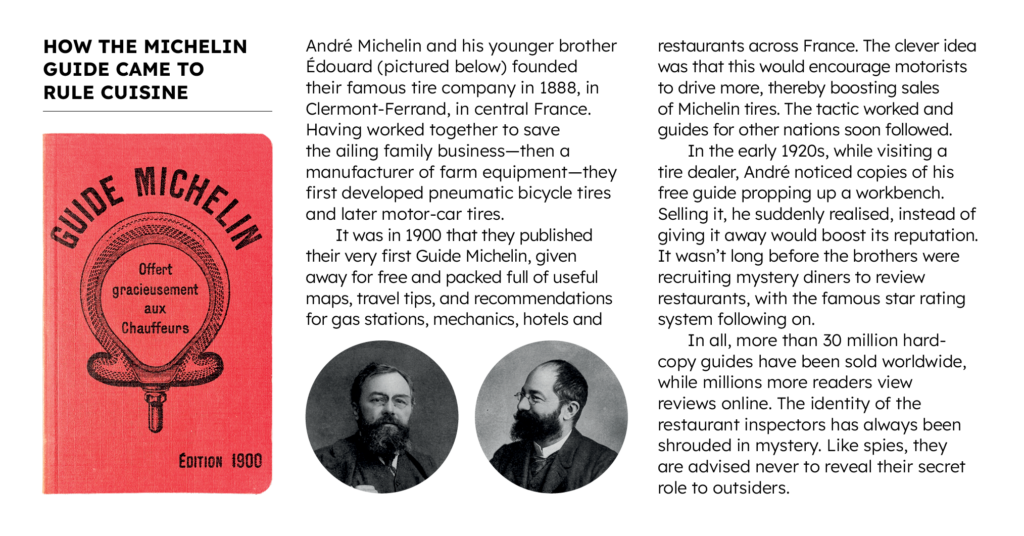
Today, Michelin rates over 40,000 different restaurants, awarding stars on five criteria: “Quality of the ingredients used; mastery of flavor and cooking techniques; the personality of the chef in the cuisine; harmony of flavors; and consistency between visits.” Interestingly, inspectors claim not to judge a restaurant’s interior decor, table setting, or service quality when awarding stars. In the guide there are currently 157 restaurants with the maximum three stars—French and Japanese establishments dominating—plus a further 514 with two stars and over 3,000 with one star.
Michelin’s position as top dog seems now to be under threat. For Generation Z, at least, influencers, social media and more fashionable restaurant guides offer more important recommendations.
The stars can be both a blessing and a curse, however. While there’s no doubt they place restaurants firmly on the culinary map, they also impose enormous pressure on hard-working chefs—both to maintain the stars they have won and to win more stars. Certain chefs have even asked Michelin to revoke their stars because they felt they created unreasonable expectations from customers or forced restaurant owners to spend extra money on service and décor. In 2019, South Korean chef Eo Yun-gwon lodged a criminal complaint against Michelin for featuring his restaurant in the guide after he had requested them not to do so. He later told CNN: “Michelin Guide is a cruel system. It’s the cruellest test in the world. It forces the chefs to work around a year waiting for a test [and] they don’t know when it’s coming.”
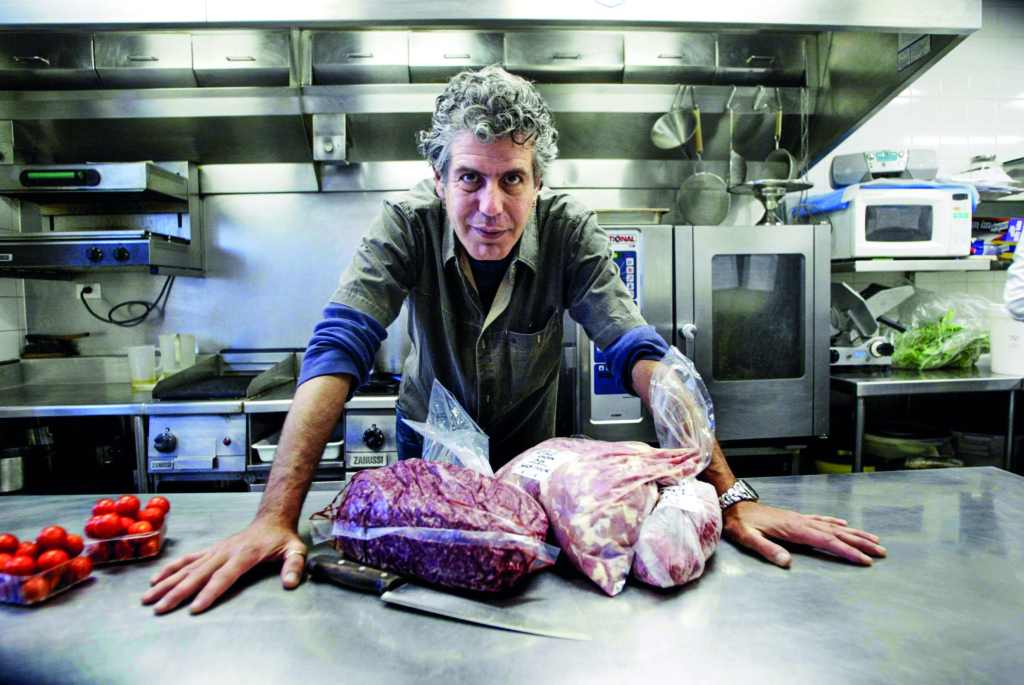
Food writer and travel documentary-maker Anthony Bourdain was also critical of the star system. “I know many of the three-star Michelins never change their menu in order to have perfect consistency,” he once said. “It’s basically robotic cuisine; they cannot afford to change, because that was the winning formula.” British restaurant critic Jay Rayner once dined at three-starred restaurants every day for a week, while researching a book. “It was an awful and deadening experience,” he said. “You are dragged into a particular setting which seems to have much more to do with status and financial heft than it ever does to do with appetite or greed.” He later added: “The idea that we need a guidebook that takes a year to produce, that is handed down from anonymous experts, feels bizarre.”
More nuanced in his opinion is Fabien Ferré, head chef at La Table du Castellet—a restaurant in the foothills of Provence, in the south of France. In 2024, at the age of 35, he became the youngest ever three-starred French chef in the Michelin Guide. While he insists there are plenty of restaurants without stars that still shine extra brightly, he in no way denigrates the guide.
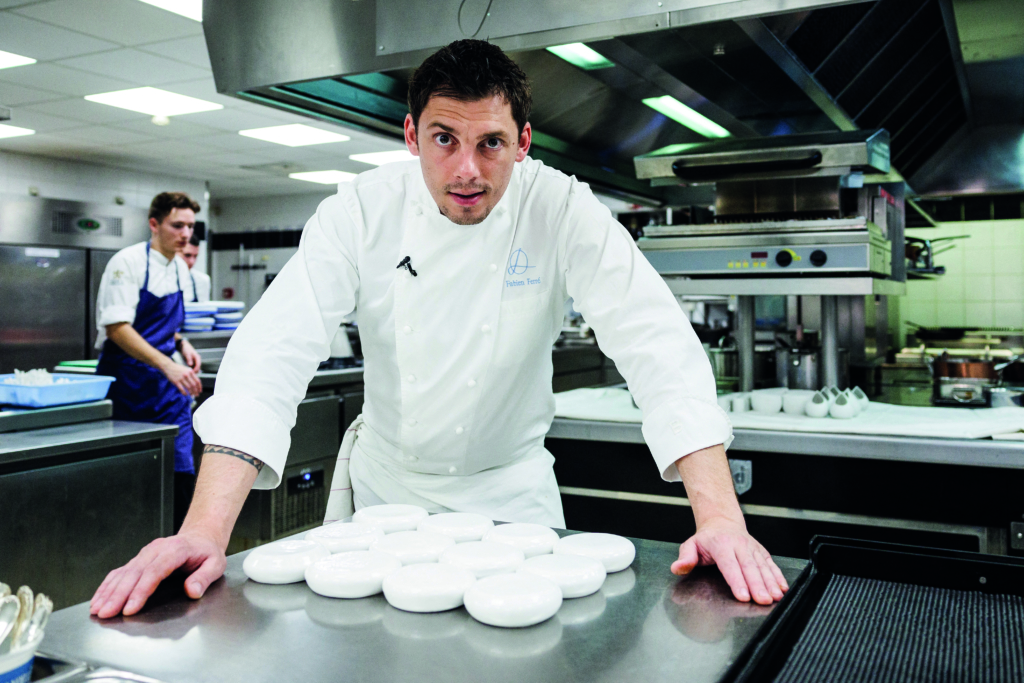
“Nowadays, one, two or three stars are a true gauge of quality,” he explains. “They also make life easier for us because they help us with publicity and recruitment. No one should spit on the Michelin Guide. It’s an excellent guide and I support it. It has put us on a pedestal and now we must fight to stay at the top.” Nevertheless, he understands there are people who believe the guide is no longer the gastronomic Bible it once was. “Even though I can’t climb into the heads of the inspectors who work for it, I’m convinced they know what they’re doing,” he adds. Perhaps the last word ought to go to Michelin itself. Understandably, the company is proud of its hard-earned reputation. “Considered by many to be the hallmark of global fine dining and quality cuisine, the Michelin Guide wields immense power over chefs, restaurateurs and foodies the world over,” it states. “It may divide opinions across the food service industry, but its influence is undeniable. French chef Paul Bocuse, a pioneer of nouvelle cuisine, once said,‘Michelin is the only guide that counts’.”
Journey in Hospitality
Journey has worked on many successful hospitality projects, including hotels, restaurants, cocktail bars, cruise ships, live music venues, airports and retail venues. One of the more unusual ones combines fine dining and contemporary art at a large restaurant called 53, in the MoMA Museum of Modern Art, in New York City. Directly beneath the new David Geffen wing of the museum, the Asian-style restaurant spans three floors and features distinct dining areas: a street-level bistro, a cellar-level main dining room, and a subterranean speakeasy. Journey was charged with designing the overall dining experience, taking its inspiration from Chinese imperial palaces, Taoist principles, and contemporary art.
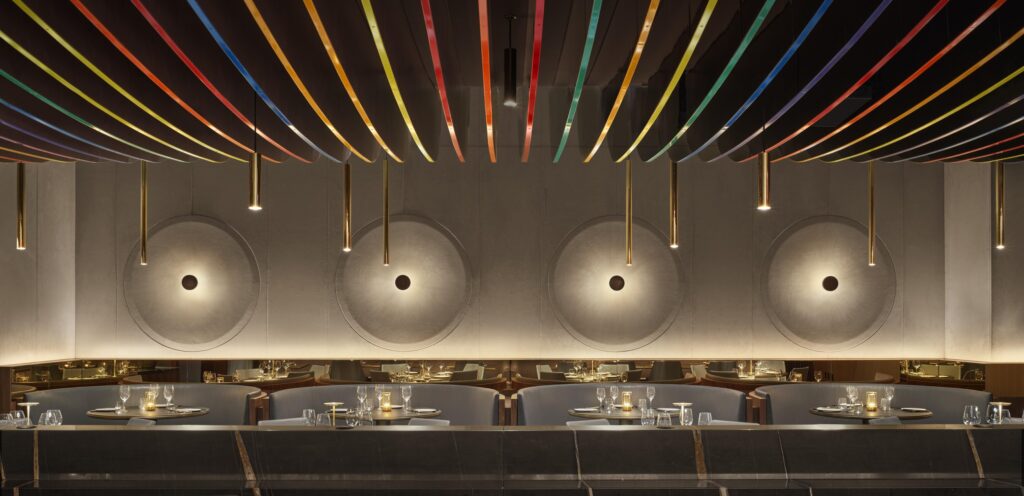
In collaboration, the renowned Friedrich Petzel Gallery has curated a rotating art program that will be displayed throughout the restaurant so that diners can move from one scene to the next, through a series of galleries. The sunken, double-height main dining room is visible from street level, bustling by day and glowing by night. The subterranean speakeasy, called Ba53ment, draws inspiration from regal Asian motifs.
This article was originally published in Journey World Magazine, January 2026.
Download Journey World Magazine – Issue 01/2026
To access the full digital edition, please complete the form below.