Earlier this year at The Roxy in New York, Journey launched a new event series exploring the growing role of experience in shaping the places where we live, work and spend our time. Opening the conversation, B. Joseph Pine II made a compelling case: experience is no longer a “nice to have,” but a fundamental source of value. In a world of scarce attention and endless choice, people increasingly seek more than utility from the places, brands and businesses they engage with — they want something meaningful, memorable and worth returning to.
But Pine’s thinking has moved on. Thirty years after The Experience Economy helped redefine how businesses think about customer experience, his latest argument goes one step further. Creating memorable experiences is no longer enough. The next opportunity, he believes, lies in helping people achieve something more lasting: transformation.
Browse the business section of a bookshop and the titles shine out like crystal balls, each offering the reader a novel view of the future. For CEOs and entrepreneurs looking to catch the next wave, the right theory can prove an invaluable source of propulsion. Best-selling author B. Joseph Pine II has form in the soothsaying game. Thirty years ago, in his landmark book The Experience Economy, he explained how businesses ought to look beyond commodities, goods and services in an effort to provide memorable experiences that powerfully engage their customers.
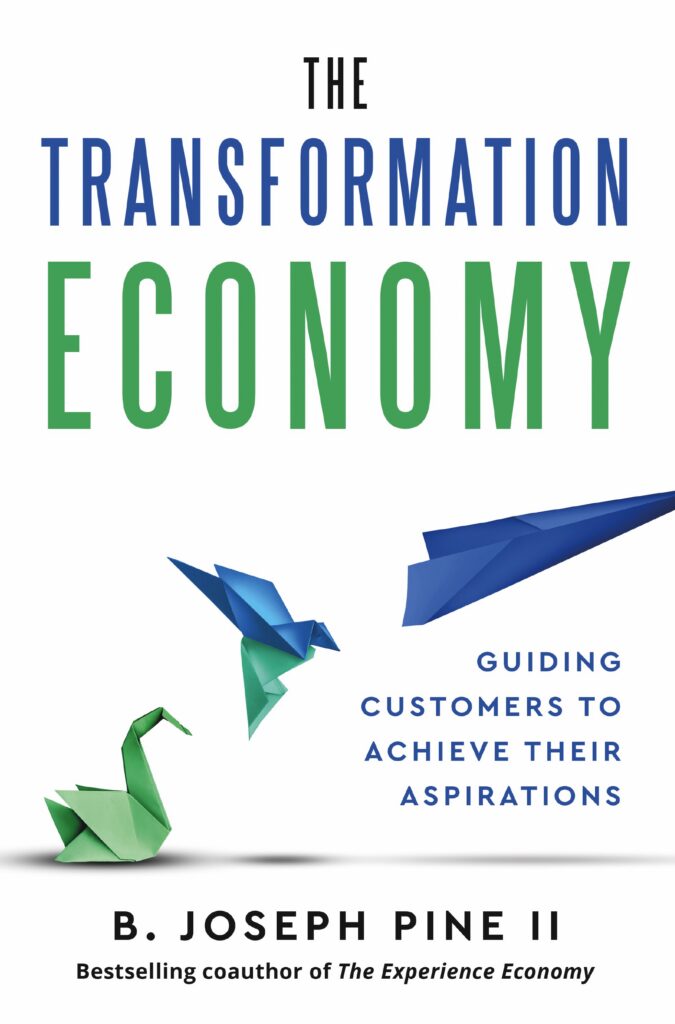
Over the subsequent decades, he has watched this vision take shape, as businesses across all industries have recognized the competitive advantages of building more intimate and longer-lasting customer relationships. Pine has walked the walk too, offering management advice to Fortune 500 companies and startups alike. Now, he has updated his world view. His latest book, called The Transformation Economy: Guiding Customers to Achieve Their Aspirations, urges business leaders to take the next step beyond experiences and actively find ways to help their customers change in lasting ways.
Companies are already missing a trick when it comes to value, warns Pine.
Those businesses that can crack the formula will thrive, Pine says. Those that don’t are on their way to becoming mere commodity suppliers to competitors who understand what their customers truly want.
From Inputs To Outcomes
The major difference between an experience and transformation is time. An experience like a concert or a vacation may stick in the memory, but the outcomes are short-lived. Life moves on. A transformation, conversely, has the power to alter who the customer is. The effects are longer lasting. A successful gym program, for example, isn’t measured in the daily number of dips and curls, but in the benefits of physical fitness. Education isn’t about class attendance, but the opportunities brought by knowledge. Take the legendary annual music festival Burning Man. Those who make the arduous journey into the Nevadan desert will encounter goods, services and experiences aplenty. But it’s the transformative effect that will stay with them for life. For ever more, they can call themselves a “burner” and fellow burners will understand. As a result, the organizers can factor this unique outcome into their pricing—and customers are willing to pay a premium.

For businesses looking to add depth to their customer experiences—effectively turning them into life-changing experiences—the first step is to really understand what those aspirations are. Pine calls this “the five whys test”. Rather than accept the first answer, keep asking “Yes, but why?” until the essence of what the customer really wants is laid bare. Is it the feelgood factor of an excellent cup of coffee you’re selling—or something deeper like a sense of fulfillment or renewed purpose? Do your customers want to refine a small area of their lives, like lowering their golf handicap, or are they reaching for total metamorphosis, like a career shift? The challenge for businesses is to understand where and how they can contribute to that change.
Human Flourishing
Transformations need not be as overt as life coaching, a wellbeing app or studying for an MBA. Pine cites the example of an Italian food hall chain called Eataly which ticks the boxes in terms of upgrading a shopping trip into an immersive experience. It then takes the next step by educating customers around the slow food philosophy and inviting them to find meaning in the simple art of Italian cooking. Eataly invites its customers on a quest of discovery in terms of healthy eating and food appreciation, but also in evolving their sense of identity. “Think of how much more customers buy from Eataly once they discover and become devoted to Italian foodstuffs and cooking,” Pine says. “Even more so if they intentionally embrace slow food.” In that sense, he suggests, “the customer is the product.”

The ends that customers desire are to have a better life or a better business. To be healthier, wealthier, wiser. To have meaning and purpose. Not just to buy, but to become who they want to become. What people want, in short, is to be transformed progress but, rather, fostering “human flourishing”. Profit is simply a metric of how well a company contributes to that flourishing. There’s another way to look at this: when companies are in the business press for the wrong reasons, it’s because they have lost their focus on human flourishing. Pine points the finger at social media companies that try to make people addicted to their products. They are acting against the benefit of their customers for the sake of short-term profits, he warns. Ultimately, it won’t end well.
Speaking the Language of Transformation
In his book, Pine carefully defines the difference between experiences and transformations—and what a meaningful transformation looks like.
- The shift from experiences to transformations is to move from creating memories to achieving aspirations.
- Transformations are effectual outcomes that change individuals in a lasting way.
- All transformation is identity change. Without a change in some aspect of self, no transformation occurs.
- Where experiences are inherently personal, transformations are fundamentally individual.
- While experiences happen inside of us, transformations change us from the inside out.
- Companies that guide transformations ideally shouldn’t refer to their customers as users, clients, or even guests, but rather as aspirants.
- The economic function for transformations is to create the conditions under which aspirants transform themselves.
- Businesses stage experiences but they guide transformations, leading customers along a journey from who they are today to who they want to become.
Transformative Journeys
Pine uses the example of Explorer X, a travel company that designs experiences to enable transformation. Dedicated to crafting highly customized journeys with lasting personal impact, the company encourages travelers—called explorers—to approach travel with curiosity, openness and intention.
“The ends that customers desire are to have a better life or a better business. To be healthier, wealthier, wiser. To have meaning and purpose. Not just to buy, but to become who they want to become. What people want, in short, is to be transformed”
A practical cornerstone of his book is what he calls encapsulation: preparing customers before an experience, encouraging reflection afterward, and supporting integration over time. Even modest experiences become more transformative when framed this way. Rather than designing solely for peak moments, companies must consider what comes before and after.
Rather than setting rigid goals in advance, Explorer X recognizes that transformation often emerges through discovery along the journey, as travelers encounter new perspectives and ways of living. Central to Explorer X’s success is encapsulation. Before departure, clients receive a guide to mindful travel, prompting them to clarify their motivations, intentions, questions, actions and way of being on the journey. During travel, explorers are encouraged to reflect regularly through writing a journal. Afterward, a journey reflection guide helps them make sense of their experiences and identify new actions, behaviors and mindsets to apply to their lives. “The most transformative sector in my experience is travel,” says Pine. “People seem to be most open to change when they leave their everyday lives—and there are lots of opportunities for companies to help them do that.”
With his new book, Pine challenges leaders to rethink not only what they sell, but why they exist. For strategists and entrepreneurs grappling with how to stand apart in a saturated economy, the Transformation Economy could be a more fruitful place to play. Guiding transformation is undoubtedly harder than staging experiences. It requires deeper insight, longer horizons and greater responsibility. But if Pine is right, it is also where the future of economic value lies.
The Transformation Economy: Guiding Customers to Achieve Their Aspirations, by B. Joseph Pine II, was published by Harvard Business Review Press in February 2026.