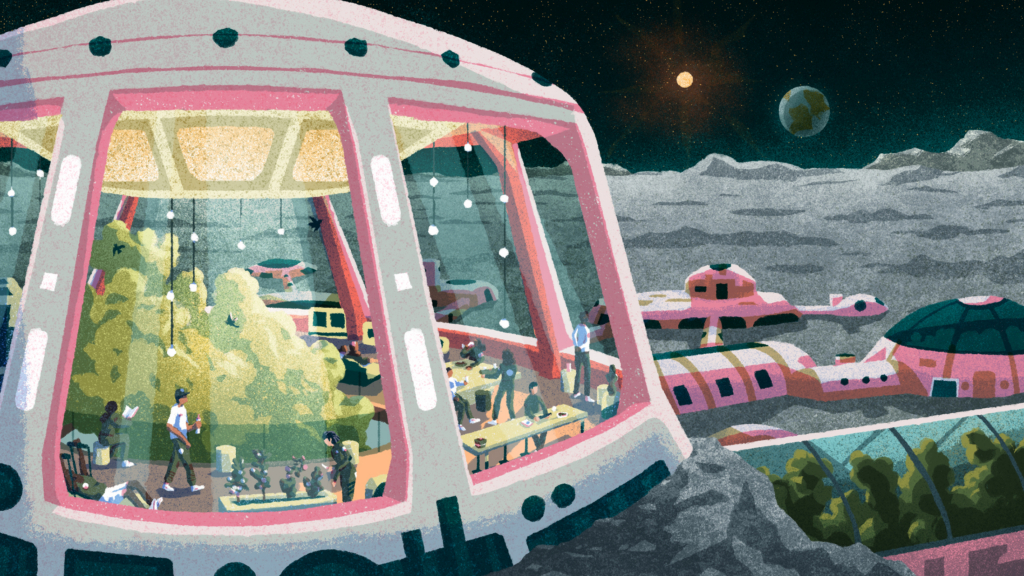

At the height of the space race, as NASA strove to put their man on the Moon, it was a Pennsylvania artist by the name of Davis Meltzer who gave us the first glimpse of what daily life on our nearest celestial neighbour might eventually look like. Beneath starry infinity, he drew dreams of a future lunar microsociety vividly spilling from dwellings dug deep into the austere moonscape. Published in National Geographic magazine, the images gave America a relatable, technicolor vision of life on another planet.
Even in the late 1960s, this was no fantastical spitballing. These drawings answered the conjecture of the sharpest scientific minds of the time; people who knew that living on the Moon would require rather more than imagination and a grin. Meltzer accounted for everything, from agriculture to dormitories, oxygenation, social spaces—even a swimming pool. All except the answer to one expensive question: given the challenge of getting a spaceship the size of a cable car to land on a rock with much less than zero manufacturing capacity, how on Earth—or rather, 384,400km off-Earth—was building any kind of structure possible?
The lack of a compelling reason to pursue lunar colonization meant this wasn’t a question that would trouble NASA for long. As of 2026, however, some 84 lunar missions have been scheduled for the next four years. With private rockets continuing to slash the cost of getting freight into space, NASA’s Artemis III lunar landing slated for 2027, and billionaire sights set ever more firmly on the real estate of our celestial neighbours, design companies are presenting space agencies with visions of how months-long habitation on the Moon might really look.
Global architecture firm Hassell is one. In early 2024, it revealed its lunar habitat masterplan in collaboration with the European Space Agency, designed to accommodate up to 144 lunar pioneers. Xavier De Kestelier is head of design at the company. “We’re comfortable with the unknown a little bit—and that’s a really good skill to have,” he tells Journey magazine. “As an engineer, you want the 100 per cent straight away. As an architect, you work in this very, very technical field. But be brave a bit, as well.”
De Kestelier is often asked if he draws inspiration from science fiction. “I always use Antarctica as a really good analogue,” he says. “You’re more remote in Antarctica in the winter than you are in the International Space Station. You’re further away. During winterization, you can’t get evacuated from Antarctica.”
Unprecedented Challenges
De Kestelier suggests the Antarctic bases Halley VI Research Station and Concordia Research Station are Earth’s closest equivalents to the harsh environments of the Moon. Nevertheless, with lunar colonization, architecture is being tasked to solve problems never faced before—deeply scary, existential problems.
Firstly, the Moon has no atmosphere to slow the hail of celestial shrapnel that has brutalized it since creation. So, any structure must have skin tough enough to withstand lethal puncture from around 33,000 ping pong ball-sized meteoroids that strike the Moon every year.
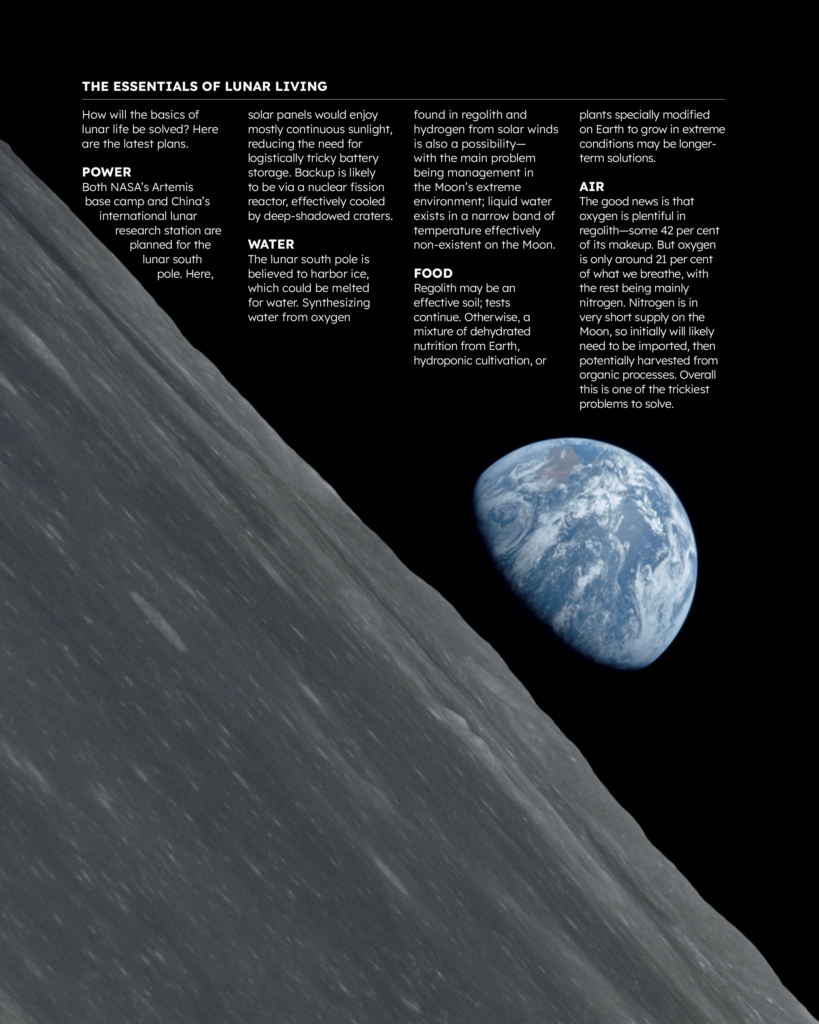
Its surface is a vacuum, so while external pressure isn’t the menace it is in the deep ocean, any human-containing vessel must be internally pressurized to around 5 pounds per square inch (0.34 bars)—our requirement to stay oxygenated, hydrated and generally alive.
With lunar colonization, architecture is being tasked to solve problems never before faced—deeply scary, existential problems.
Sustenance is a challenge, given lunar water is likely difficult to utilize, if present at all. Temperatures swing from above boiling in the sunshine—260°F or 127°C—to well below the lowest Antarctic winter at night, or around minus 208°F (minus 133°C). There is the problem of construction materials. With NASA estimating a cost-per-pound upwards of $10,000 to ship materials from Earth, De Kestelier stresses how local materials will be essential. The primary resource is regolith, a pesky mix of weathered rock and dust.
Then there is arguably the biggest challenge: radiation. Galactic cosmic rays and solar particle events are deflected by Earth’s atmosphere, but no such protection exists in space from their potential effects—which range from cancers, to DNA damage, to radiation sickness. Any structure would need substantial shielding; simply planning to live underground overlooks the spicy issue of being able to dig sufficiently into the surface.
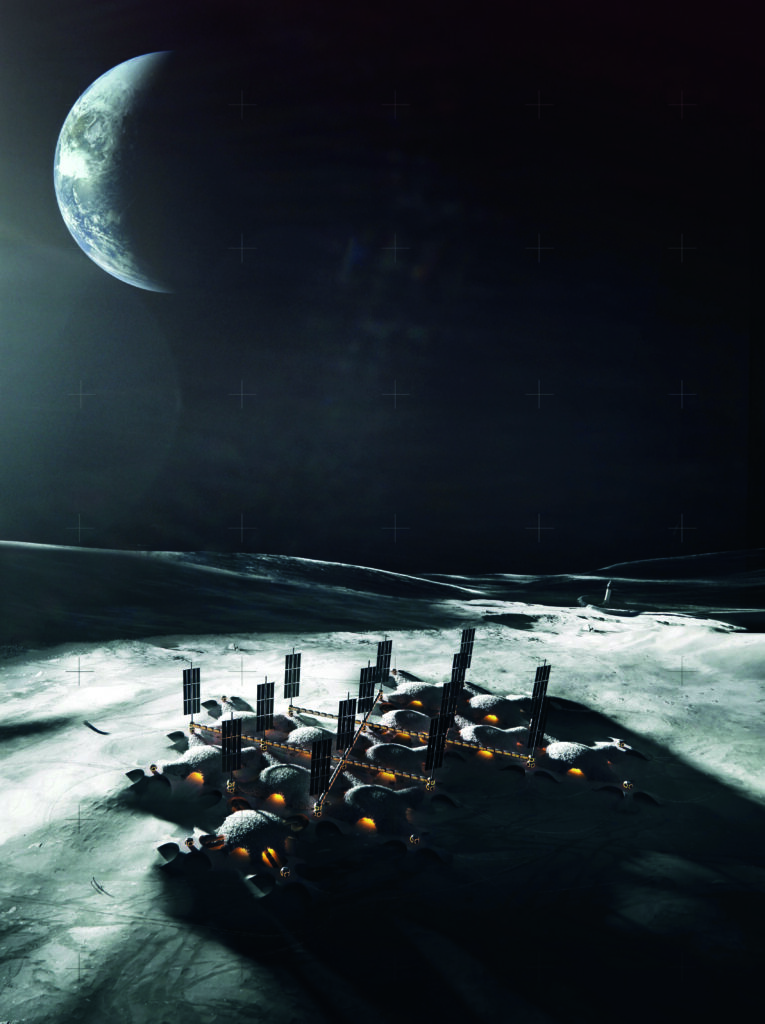
Some speculative solutions are emerging, however. De Kestelier confirms Hassell’s designs are “modular and scaleable”—in other words, big things built from smaller things, and growing over time. In his team’s vision, initial habitable structures will comprise modular, inflatable, pill-shaped structures, as rounded walls handle pressurization more effectively than straight sides. Radiation could be shielded against using interlocking pods similar to the concrete tetrapod structures used for coastal defences. These could be 3-D printed from regolith and stacked to break the path of those deadly lunar winds.
The Human Factor
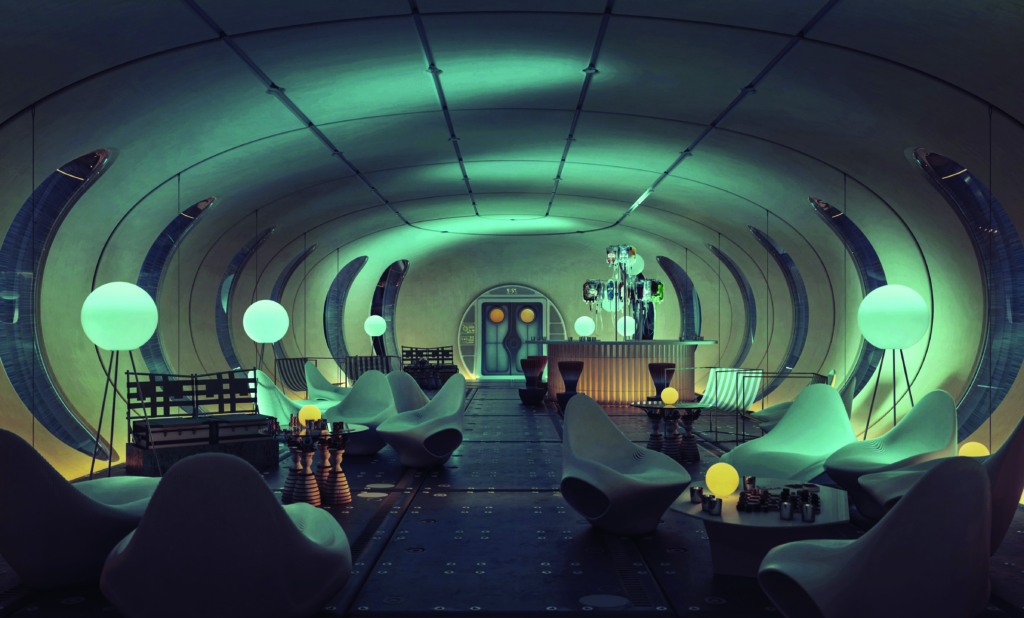
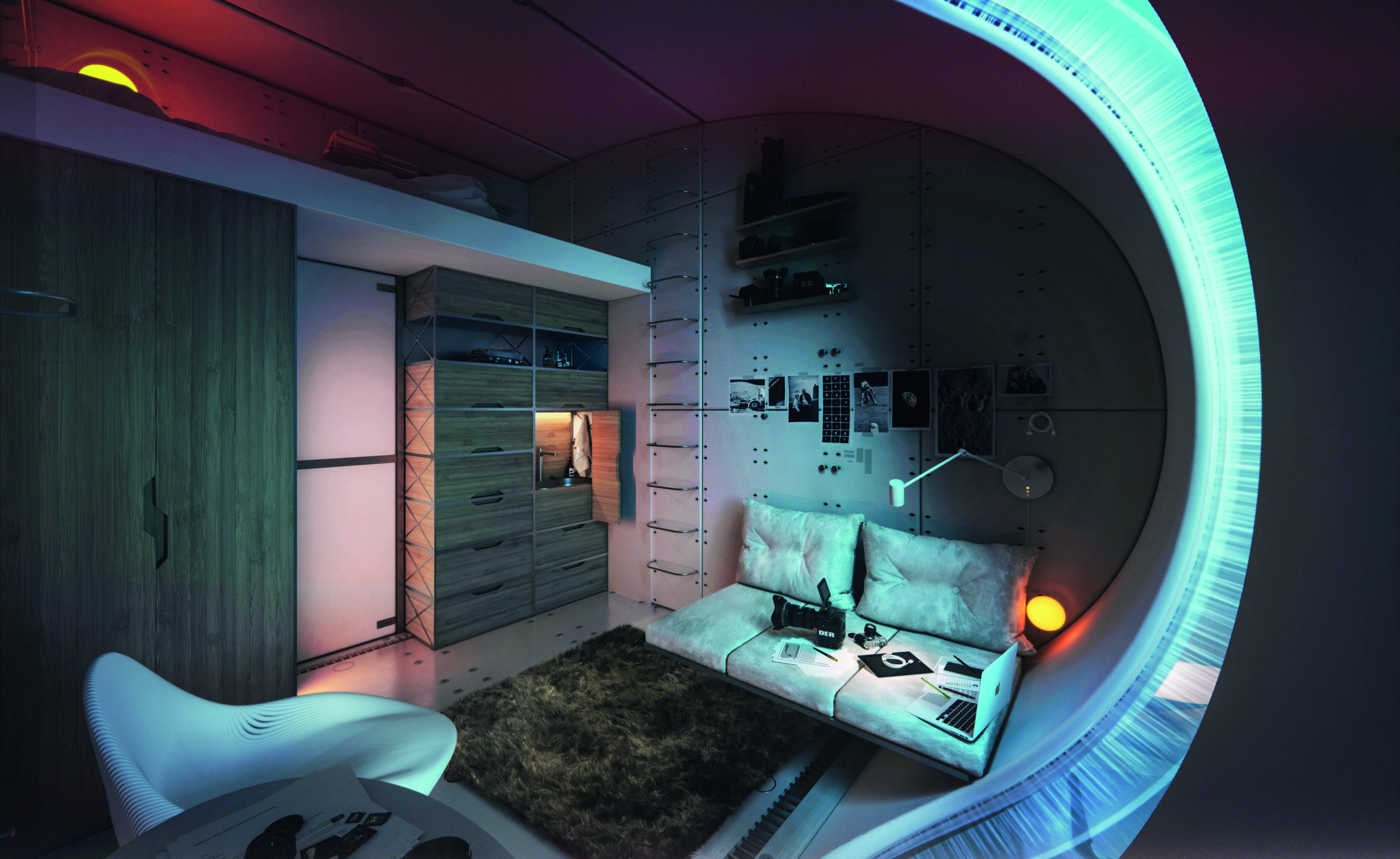
“But as De Kestelier explains, while most challenges can be overcome with technology and engineering, one cannot. “The tricky thing is a design that people feel is their home—to have normal life in a completely internalized space,” he says. “How do you make these spaces more human?”
“The tricky thing is a design that people feel is their home—to have normal life in a completely internalized space. How do you make these spaces more human?” Xavier De Kestelier, head of design at architecture firm Hassell.”
Given an astronaut’s life is structured minute-to-minute, nuance can be forgotten in the pursuit of utility. “It shouldn’t look like the inside of an angry machine,” De Kestelier says, noting that the original designs of 1970s space station Skylab lacked a communal dining table until industrial designer Raymond Loewy proposed it. “Having a conversation while having a meal… such a human thing to do. The other thing he added was a window. Imagine going around the Earth for months and never seeing Earth, because from a pure engineering perspective, a window is a weakness in the shell. But the astronauts used that window the whole time.”
He references the International Space Station’s radial window—or Cupola—that took 23 years to develop, and was once canceled by NASA because they failed to appreciate its function. “Now it’s the most famous space in the ISS,” De Kestelier adds. “This is where they take the pictures, where they play the guitar.”
Moon-dwellers will also need leisure space for sports and exercise. And the Moon’s low gravity—one sixth of Earth’s—will affect the design of the habitats, requiring strategically placed grab rails, taller ceilings for those bouncing steps, little need for stairs, and superhuman games of basketball. Not the swimming pool that Davis Meltzer’s envisaged, though; in reduced gravity, De Kestelier says, “the waves might really get wild.”
Material Matters
But first, the basics of sustainable structures need to be refined right here on Earth, which means a lot of homework. Lunar regolith is a menace. It is sharp, electrostatic, abrasive and hazardous to health. Get a robot to heat and harvest it, however, and it’s full of useful things such as iron, aluminium, magnesium, sil and oxygen. If we’re going to build anything on the Moon, we must learn to love it.
Florida-based Space Resource Technologies (SRT) manufactures simulant regolith for space researchers to test their lunar-bound equipment, using samples and data from the 1970s Apollo program to faithfully recreate it from terrestrial minerals. “Imagine the texture of baking flour mixed with coffee grounds—kind of,” says Anna Metke, owner and head of SRT, of regolith. “The Moon gets hit by micro-meteorites constantly. The energy from these impacts melts the regolith, leaving behind tiny bits of glass that keep getting shattered again and again. The result is a thin layer of sharp, fluffy glass spread across the Moon’s surface.”
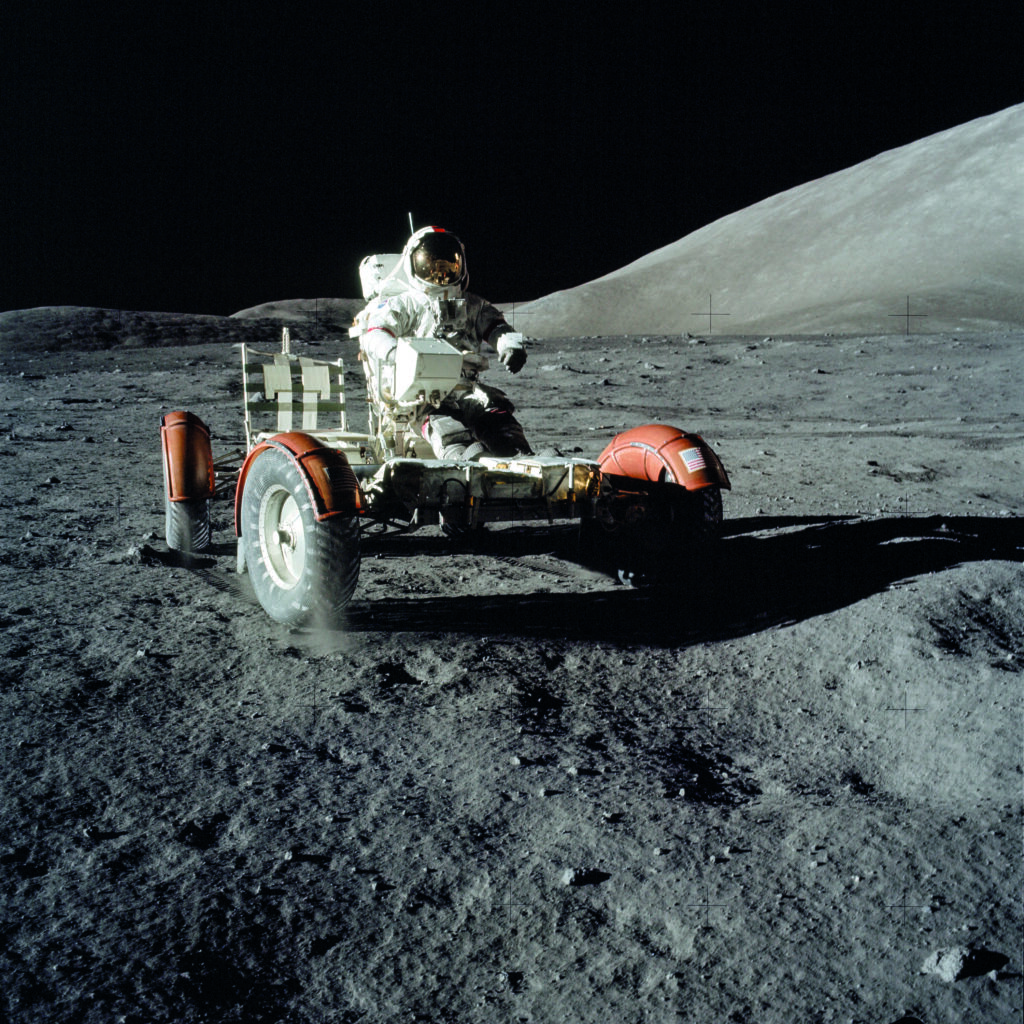
This dust, rather like our own dear sand, gets everywhere, presenting hazards for anything milling around in it. SRT goes as far as smashing its regolith simulant to achieve just the right sharpness, then sorting it into a range of sizes to match particle distribution on the Moon. “All of this accuracy matters when you’re testing hardware,” Metke adds. “Rover wheels need to grip without sinking, gears have to tolerate ultra-fine dust, and electronics need protection from particles that stick in very specific ways. The mineral makeup, the shape, and the size all affect how the hardware survives.”
Said hardware will be fundamental to any lunar settlement, and careful testing, Metke says, is critical. The European Space Agency’s failed Beagle 2 Mars lander is a case in point. “Accurate regolith simulants are the closest we can get to replicating the Moon here on Earth—whether it’s figuring out how to 3D-print with lunar dust, grow plants in regolith, build landing pads, or extract aluminum from the surface,” Metke notes. “We spend billions sending this equipment to space. It’s kind of embarrassing if we don’t prepare properly.”
Davis Meltzer’s 1960s illustrations, then, weren’t that far removed from the reality most contemporary developers are currently pursuing. And the frontier remains the same: create civilization where it isn’t. Right?
Xavier De Kestelier is keen to manage expectations. “At the moment, for the Moon and Mars, we’re far away from establishing civilization,” he warns. “These are extremely harsh environments. There will be more people, for longer periods of time; for research, for exploration, for tourism, probably. But will you go and live there? I don’t think so.”