

Does anybody even go to the mall anymore?
Underutilized, misunderstood, and in need of reinvention, malls might look like an unlikely candidate for revitalization. Empty storefronts dot their corridors, their foot traffic has dwindled, and decades of pop culture have cemented them as post-apocalyptic wastelands, from Dawn of the Dead (1978) to The Last of Us (2023).
But malls represent some of the most compelling architectural opportunities of our time. With built-in infrastructure like climate control, parking, and multi-level circulation systems, they offer a foundation that would cost hundreds of millions to recreate from scratch. They provide immense potential for third spaces, experiential retail, and location-based entertainment.
More importantly, their cultural mark on our collective psyche runs deeper than most realize. Think about teenage hangouts, trips to the arcade, or favorite movie theater visits, and you inevitably think of a mall.
The original mall concept was designed to promote social interaction and shared experience. At their core, malls were always meant to be gathering places. With the right vision, they could be that again.
The question isn’t whether malls have a future, but what kind of future we’re willing to imagine for them.

Suburban sprawl and shifting attitudes: A brief history
To understand how malls could evolve, we need to understand where they came from — and the idealistic vision that created them.
Victor Gruen, often called “The Father of American Malls,” never intended to create the sprawling commercial facilities we know today. The Austrian-born architect and urban planner had pioneered the concept of “window shopping” with dazzling storefronts. But as he designed more retail spaces across America, he became increasingly frustrated with suburban sprawl and the growing overreliance on cars.
His solution? Malls. They were intended not just as shopping centers but as ways to combat the isolation that came with all that time spent alone in suburban houses, missing the organic socialization of urban environments.
At first, malls delivered on their promise. They became an indelible part of American culture, a 20th-century town square for a car-dependent society. Teenagers formed friendships in food courts, families made weekend rituals of mall visits, and entire communities formed in their climate-controlled corridors.
But somewhere along the way, malls began to exacerbate the very problems they were designed to solve. Critics emerged, and their observations were damning. In 1975, Joan Didion called them “toy garden cities in which no one lives but everyone consumes.” The American architect Louis Kahn was even more blunt, dismissing them as “stupid” spaces that “look like some of the abandoned American West.”
Most tellingly, Gruen himself disowned his creation. By 1978, he declared: “I am often called the father of the shopping mall. I would like to take this opportunity to disclaim paternity once and for all. I refuse to pay alimony to those bastard developments. They destroyed our cities.”
Today, many malls have indeed lost their cultural and economic relevance. They’ve become ghost towns, failed monuments to American consumerism. They embody what Jacques Derrida called “hauntology,” where the present is influenced by lingering traces of the past and its unrealized expectations.
But this haunting presence might actually be malls’ greatest asset. Buried beneath decades of commercial disappointment is Victor Gruen’s original vision for connection, and quite possibly the blueprint for their future success.
The untapped potential of the American mall
Despite where they’ve ended up today, malls remain spaces of beautiful contradiction. They’re simultaneously symbols of American excess and evidence of our deep hunger for connection. They also contain great potential: Historically, malls served as essential third spaces for suburban communities across America, and they’re poised to reclaim this role.
Malls already have major social pull in other countries. In South Korea, malls like the Starfield COEX Mall (with accompanying library) and Lotte World Tower & Mall (with observation deck, skywalk, and concert hall) function as cultural epicenters where people can spend entire days socializing. In Hong Kong, K11 Musea offers not only luxury shopping but also dozens of destination restaurants, artist installations, and educational programs to encourage connection. And in the UAE, shopping centers like Mall of the Emirates and the Dubai Mall have become immersive lifestyle destinations with aquariums, indoor ski slopes, ice rinks, and more. All of them offer a model for what American malls could become if we thought beyond the traditional retail programming.
The potential, after all, is immense. Malls are fundamentally mini-cities equipped with all the infrastructure needed to support diverse programming: food service, entertainment spaces, gathering areas, and the kind of climate-controlled comfort that makes them accessible year-round. More importantly, they have the potential to address the modern sense of isolation that runs even deeper than the suburban loneliness Gruen was originally trying to solve.
But the old model of malls, anchored by department stores and organized around consumption, no longer fits the ways we seek connection in the 2020s. People today are looking for authentic social interaction, unique experiences, and a shift away from mindless retail consumption.
The infrastructure and the cultural hunger are there. The time is ripe for malls to reclaim their role as meaningful third spaces. What’s missing is intentional design and innovative programming.
Shaping the future of malls and experiential retail
The good news is that this vision is already taking shape across the United States. Forward-thinking developers, educators, and community leaders are proving that malls can be successfully reimagined for dining, athletics, art, tech company headquarters, and more.
In Missouri, the former Red Roof Mall now houses Ballparks of America and its replicas of Major League Baseball stadiums. In Texas, Austin Community College converted Highland Mall into Highland Campus. And in New York State, the old Sears store in the Irondequoit Mall has been transformed into an amenity-filled senior housing community with over 150 residences.
Designers and developers need to dig more deeply into the conversation about reinvention and find ways to harness malls’ cultural legacy. A complete overhaul isn’t always the answer. There are plenty of ways we can adapt malls for contemporary use while preserving what makes them unique.
One promising approach involves reactivating existing malls with new programs and anchor tenants that honor their original function, but with contemporary updates. Take Le District, which entered as a new core tenant at Brookfield Place and created a destination that captured and elevated the essence of what made mall food courts special. By bringing together tastes from Morocco, Montreal, Paris, and Provence in a hub of restaurants and food markets, Journey’s design created a foodie mecca that lets people connect over meals. It’s the same social function as the old food court, but reimagined with contemporary sophistication.
That’s not the only option, either. Rather than just bringing new programming to malls, we’re also seeing the best parts of mall culture exported to other retail formats. Department stores are borrowing from the mall playbook, creating diverse ecosystems of experiences, brand interactions, and food and beverage options within single locations.
One example is Shaver Hall, a food hall opening in Midtown Manhattan within the historic Lord & Taylor building. With 11 curated food stalls, including Omakase options, a wine bar, and modern bodegas, the concept brings an upscale food court approach to the former department store. On a similar wavelength, Macy’s Herald Square flagship has introduced pop-up coffee shops and social spaces that encourage visitors to linger, socialize, and keep engaging with the brand.
Imagining the “mall of experiences”
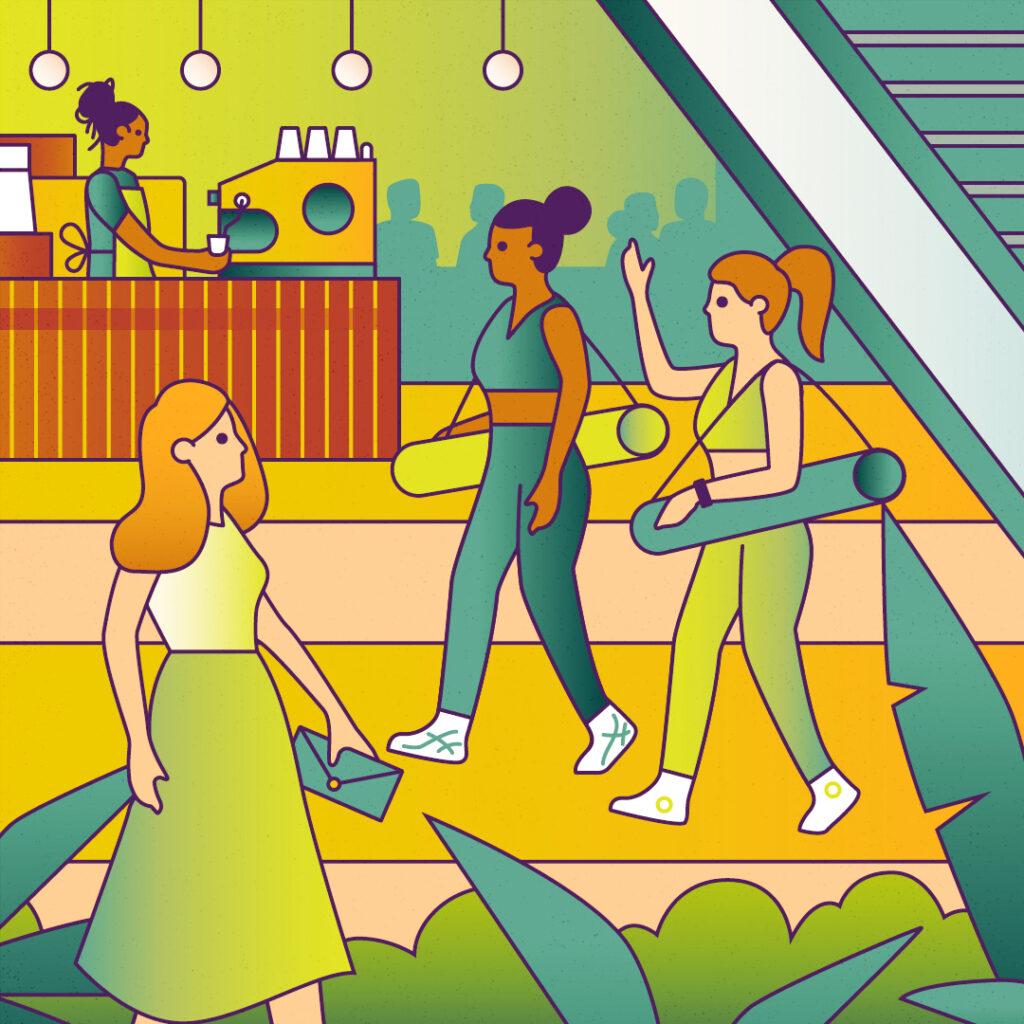
What would malls look like if you removed the shopping entirely but preserved their emotional, social, and cultural qualities? The answer lies in the “mall of experiences”: a reimagined third space that replaces retail with immersive, interactive entertainment.
Area 15 in Las Vegas is a perfect example of the concept. It feels like a mall but offers surreal art installations and a series of interactive experiences instead of stores. Its anchor tenant, Meow Wolf, has proven that large-scale immersive art can draw the same crowds that department stores once did, and its other attractions keep people coming back for flight simulators, arcade games, axe throwing, AR dodgeball, and more.
Netflix is taking a similar approach with its upcoming Netflix House locations in Philadelphia, Dallas, and Las Vegas. Once inside, visitors can engage with fan-favorite content in all sorts of ways: immersive story-driven experiences, selfies with key characters, a restaurant menu inspired by hit shows, and a shop full of themed merch. It’s like a mall… only every “store” is an adventure from a Netflix series, every experience rotates so there’s always something new, and it all comes together in an experience that can’t be streamed at home.
The mall of experiences works because it taps into something deeper than novelty. In a world where you can buy almost anything online, what you can’t replicate is the thrill of active participation, the unpredictability of live interaction, and the satisfaction of an experience wholly unique to your visit. The mall setting is essential, since it offers a large venue where visitors can actively move from room to room, choosing their own adventure and co-creating their own experience.
For developers, the mall of experiences provides a way to fill large spaces with programming that generates repeat visits and social media buzz. For visitors, it answers a growing demand for heightened personalization and choice in an era where many experiences have become flattened and universal. Most importantly, it preserves what made malls special in the first place: the sense of possibility, the social energy, and the feeling that something exciting might be around every corner.
It’s time for developers, retailers, and architects to recognize the potential in spaces that everyone else has written off. It’s not enough to settle for surface-level transformation; as designers, it’s up to us to develop design solutions that reflect how people actually want to live, work, and connect. By approaching each project as systems thinkers as well as aesthetic designers, we can read the social currents that shape our world and translate those insights into environments that better serve our communities.
The story of the American mall isn’t ending. It’s being rewritten by people willing to see its enduring potential for human connection. And the lessons we learn from mall revitalization, from preserving cultural relevance to reinventing spaces that serve both emotional and economic needs, apply far beyond retail.
They’re a blueprint for reimagining any space where the original purpose has evolved but the fundamental human need for choice and connection remains. Old department stores, unused office spaces, dying downtowns — each one is an opportunity to create something better than what came before, something that honors the past while serving a bold new future.