

Picture this: The year is 2030. You’ve just wrapped up your four-day work week and are ready for the weekend. Your autonomous vehicle pulls up, more punctual than your last date, ready to take you to dinner. As you settle in, a custom-generated documentary on home renovation — your latest social media obsession — flickers to life on your spatial computing device.
Complete the form to access the full content.
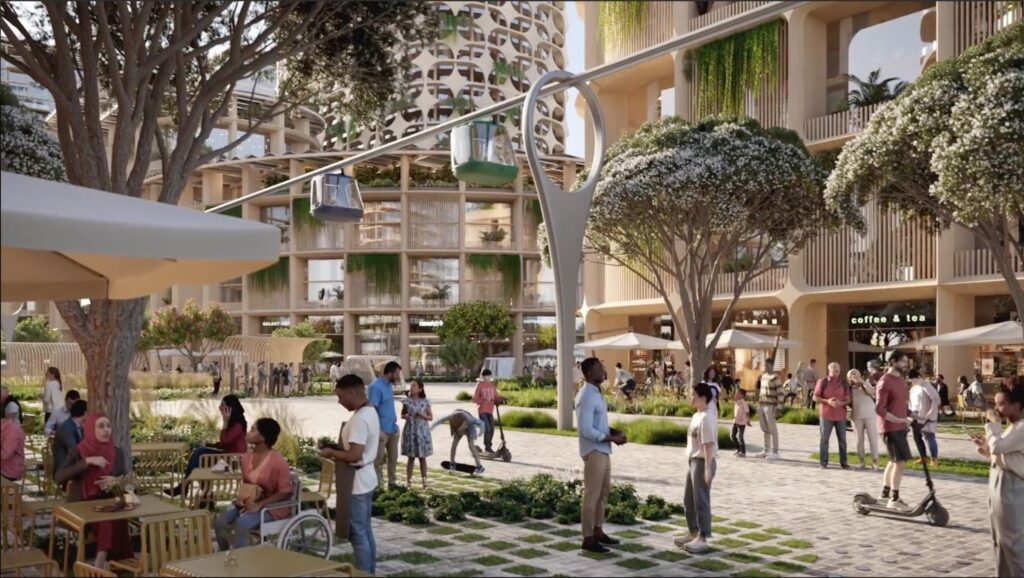
Our 2030 predictions may sound like sci-fi, but they’re closer to reality than the headlines suggest. In the next decade, AI will have adapted advanced capabilities such as contextual understanding and creative problem-solving; this will fundamentally transform the way we work and live.
New professions like AI interface designers and Turing testers will emerge. Generative AI will be a feeder technology for other emergent technologies, especially spatial computing, quantum computing, autonomous vehicles, manufacturing, and more. It will help us navigate the complex economic landscape of the future. AI will shape national policies, alter our cities and homes, and change societal norms in ways we are only beginning to imagine.
The result will be a major transformation in many facets of our daily lives and in key sectors like retail, hospitality, and entertainment.
A paradigm shift from doing to managing
Welcome to the brave new world of AI, where the biggest shift isn’t just about embracing new tech but also stepping up as the managers of our very own AI teams, or agent swarms. It’s a bit like suddenly being promoted to the boss of a very efficient, if somewhat robotic, staff. Most of us aren’t used to delegating our daily tasks, let alone to a team of digital agents. But ready or not, we’re all about to become the unofficial CEOs of our personal AI enterprises.
This future might be nearer than we think: Open AI has already made it possible for people to build their own rudimentary ChatGPT-based bots. By 2030, we’ll be able to customize advanced, task-based swarms of agents. These AI swarms will either live within specific technical platforms or will have the interoperability to move among different channels in our lives. For example, someone who wants to start their own small business would create an AI agent customized to give business advice, help with filing taxes, and understand their daily productivity patterns.
As we near 2030, we’ll also see AI agents who can work with more autonomy and develop their own solutions to drive outcomes for humans. AI tools already tackle basic research, writing, and summarization. For instance, they can suggest tropical vacation destinations and even offer a sample itinerary. But the next wave of AI — contextualizing, planning, executing, and decision-making — will be able to ingest our goals for an upcoming vacation before interpreting, planning, and booking the exact right amount of relaxation, family time, and sightseeing on our behalf.
Over the next decade, most tasks will fall into four categories:
- Legacy human tasks with digital engagement: In other words, humans performing tasks the way we do with online tools or apps today. Think typing search terms into browsers, manually paying online bills or submitting shopping orders, making reservations on a website, and more.
- Co-piloted engagement: We explicitly assign a task to an AI agent, and it completes the necessary steps. This might look like giving instructions to book a treatment on a certain day at the best Yelp-rated spa in your city.
- Augmented self-directed engagement: AI anticipates our next request and provides assistance. For instance, an agent will automatically download and fill out medical forms for us after we make a doctor’s appointment without being told to.
- Proactive, AI-led engagement: By 2030, we’ll be just on the cusp of this more advanced technology, which will enable us to take the initiative and complete complex tasks without prompting. For example, suppose you’re moving to a new city. In that case, this kind of AI tool will be setting up its own to-do list — which might include obtaining quotes from movers and home insurance providers, making a packing list, scheduling an appointment with the local DMV, and more.
Smooth, easy, personalized: our improved daily experiences
AI will fundamentally change how most of us spend our time, transforming the fabric of our lives. It is distinctly possible that our work weeks will be reduced, our time spent on menial tasks will diminish, and our available time for “consumption” of experiences and products will increase. This shift will free up time for more leisurely pursuits, including hospitality, shopping, and entertainment.
Day-to-day tasks will become much easier, with “nocturnal AI” able to complete tasks overnight that you assign before you go to bed. Technical execution will also become incredibly easy. We’ll be able to ask our AI agent to whip up a virtual game based on a certain subject matter and customized to the player’s age and device — teaching an 8-year-old about different types of trees in the style of a puzzle game on an iPad, for instance. The same will hold true for creating websites, widgets, images, videos, and even apps.
AI tools will also let us layer our interests into our daily lives. Consider how you might pair your favorite educational apps with your everyday chores and errands. Want your shopping list to teach you new vocabulary words in Spanish? Great!
Overall, AI tools will make our daily experiences feel more frictionless, customized, and dynamic. Every consumer experience will feel like a one-on-one interaction — or, at the very least, like it’s wrapped in a personalized container.
Retail Renaissance: how AI will reshape shopping
Gone will be the days of stumbling through a home improvement store trying to figure out what you need. Based on your search history, your AI agent will identify the right tool or part and direct you to the nearest store with it in stock. You’ll then sit in a lounge area while a bot uses smart wayfinding tech to do the aisle-searching and assemble your order for you.
Retail will no longer be constrained to physical locations or digital sites, either. Spatial computing will allow almost any product to be bought in almost any location. A visually immersive retail display will exist anywhere the consumer wants to explore products in 3D: at the stadium, in the pickup line at school, or in the doctor’s waiting room. Physical businesses will also invest in virtual twins of their physical premises to expand existing store layouts into the metaverse and facilitate uniquely immersive shopping experiences.
AI and just-in-time manufacturing will also enable and enhance hyper-customization. This will open the door to new models, such as revenue sharing, as consumers will be able to customize their favorite items for other shoppers to buy. People can become co-producers in their favorite retail environments, even gaining derivative income from their user-generated products (UGPs).
Hospitality 2.0: seamless service for guests
The key to success in hospitality in 2030 will be personalization and proactive action. Hotels that leverage new AI technologies to solve problems and make travel experiences feel luxuriously customized will emerge ahead of the pack. These hotels of the future are already being designed, and their doors will be open by 2030. Choosing not to evolve — and not to start that evolution now — would be a mistake.
From your wake-up times to your dining choices, you’re a different traveler when traveling for business versus with friends versus with family. By 2030, AI will be able to recognize these different travel personas and customize your hospitality experience to feel more luxurious and bespoke. Once you’ve made your reservation, the AI assistant can begin to plan your customized stay, plotting a morning jogging route that takes you past some of the sites you’ve bookmarked or recommending restaurants near the top-rated Negronis in the city.

Guest experiences will be broken into legacy and augmented tiers, with travelers able to unlock higher tiers for more customized experiences. For example:
- A customized AI concierge will be able to curate individual itineraries, menus, and entertainment options that suit your interests.
- The toiletries and minibars in your hotel rooms or cruise cabins will be customized to include your favorite types of scents, snacks, and drinks.
- A dynamic and proactive problem-solving agent will automatically make adjustments to dining reservations based on shifts in your calendar.
Coming to a theater near you: advancements in entertainment
With AI freeing us from both menial tasks and the five-day work week, we’ll have much more time on our hands. As a result, the demand for quality entertainment will skyrocket.
By 2030, everyone will still have their smartphones, but some early adopters will be wearing the Vision Pro. That means that movies and television will become untethered from their current digital platforms and physical locations. You’ll be able to immerse yourself in the newest blockbuster movie on your Vision Pro 5 while sitting in the park — and you may even be able to swap in your favorite actors.
As in the hospitality and retail sectors, the outcome will be the hyper-personalization of experience. We’ll likely be able to create on-demand custom entertainment, with generative AI platforms bending existing content to our creative desires or even producing 100% custom content for us. Want to learn about the Battle of Waterloo? AI can create a custom 20-minute podcast that covers the topic. Got a dinner party coming up? AI will whip up a three-minute video on the top five ways to make a martini.
This could, of course, lead to the creation of deep silos of culture. But it will also enable artists to produce award-winning films, albums, and TV series from almost anywhere, broadening cultural output worldwide.

For in-person entertainment, augmented reality, and spatial computing will have a massive impact on the industry. Concerts and other events will offer tiered tickets, with basic access at the bottom and higher-tier AR experiences that might include avatars, tradable tokens, overlaid stats or song lyrics, virtual easter eggs that can be discovered by exploring the venue, and “hidden menus” that help event-goers mix and adjust what they want to experience. These add-ons will extend outside the event, with exclusive virtual content playing during rides to the venue in autonomous vehicles and more.
Strategic Planning for the Next Decade: Navigating the Tech Revolution
2030 is not that far away. Organizations should remember that innovation rarely stays in its lane, and upcoming developments in AI, spatial computing, and other technologies will play off each other. New products and services will be interdependent, and cross-disciplinary collaboration across industries will become increasingly vital. It’s time to stop taking baby steps and narrowly planning for next year’s tools.
Instead, companies should start discussing how to leverage the next decade’s advancements across the broad spectrum of emerging technologies and interrelated industries. That’s one of the reasons why Journey took the proactive steps to form a creative studio that uses emerging technologies to interlink the physical and virtual worlds: We knew that we’d need this kind of vision and connectivity to help organizations navigate the coming years.
Major disruptions like the upcoming AI revolution don’t happen in siloes, and our interdisciplinarity is already helping clients plan for the future — whatever it may hold.